South Saint Paul, MN
Radon Testing Services in South Saint Paul, MN
Radon has no smell, no color, and no taste, which means a basement can hold elevated levels for years without a single warning sign. The gas enters through foundation cracks, construction joints, and gaps around service pipes, and prolonged exposure is linked to lung cancer, so the only practical answer is a measurement. Many people assume a newer or well-sealed house is safe, but radon is a soil gas, and building age alone does not predict a reading. Families, landlords, and buyers searching for calibrated radon testing in South Saint Paul, MN usually want a clear number and a clear next step.
Statewide figures explain why testing is routine in Minnesota. The Minnesota Department of Health estimates that 2 in 5 homes exceed the 4.0 pCi/L action level, and the city recorded 8,756 housing units in 2020. Basements, slabs, and sump pits all create contact points with soil, and no two houses behave the same way, so real estate radon inspections in South Saint Paul, MN give buyers, sellers, and agents documented numbers instead of assumptions about any one house.
Over 10 years of radon work gives our crew a clear picture of how readings translate into decisions. As 1st Defense Radon Testing And Mitigation, we've provided professional radon testing services in South Saint Paul, MN, with calibrated monitors, documented placement, and reports that explain results in plain terms. Owner involvement keeps the process organized, and each report points toward the next step. Explaining what a number means is as important as measuring it, so reports come with clear guidance and questions are answered before and after the test.
About South Saint Paul, MN
South Saint Paul was incorporated on March 2, 1887, and grew into a major meat packing location anchored by livestock stockyards that closed in 2008. That industrial past shaped the city, and many residents trace their heritage to Southern and Eastern European immigrants who settled there while the packing industry grew. Today the city is a compact residential community with long-established neighborhoods.
Census counts in 2020 showed 20,759 residents across about 6.07 square miles, roughly 5.63 of it land. That works out to a density of 3,690.7 people per square mile, and the city sits at an elevation of about 719 feet. Vacancy was low, at 3.7 percent of housing units in 2020.
Housing is mostly single-family, roughly two-thirds of the supply, and about 63 percent of units are owner-occupied while 33 percent are rented. Only 2 percent of the housing stock dates from after 2009, so the city's neighborhoods are largely settled, long-standing places rather than new development.
How Older Housing Stock and Minnesota Disclosure Law Shape Radon Testing Services in South Saint Paul, MN
The city's housing assessment reports that about 60 percent of homes were built before 1960 and about 25 percent before 1940. Foundations that old have had decades of settling, and radon can slip through cracks, joints, and openings around pipes in a foundation of any age, so older basements deserve a measured look rather than an assumption.
Minnesota law adds a second driver. Since January 1, 2014, sellers must tell buyers whether radon tests have been done, provide the most current reports, and describe any mitigation, along with a radon warning statement. Buyers and sellers should plan for these disclosure rules early in a typical home sale.
Winter keeps homes closed up, which resembles the closed-house conditions testing protocols call for, and basements used as living space put people closer to the lowest level. About a third of the city's units are rented, so landlords and tenants have an interest in documented results too.
Our Services in South Saint Paul, MN
How Radon Testing Services Measure a Basement in South Saint Paul, MN
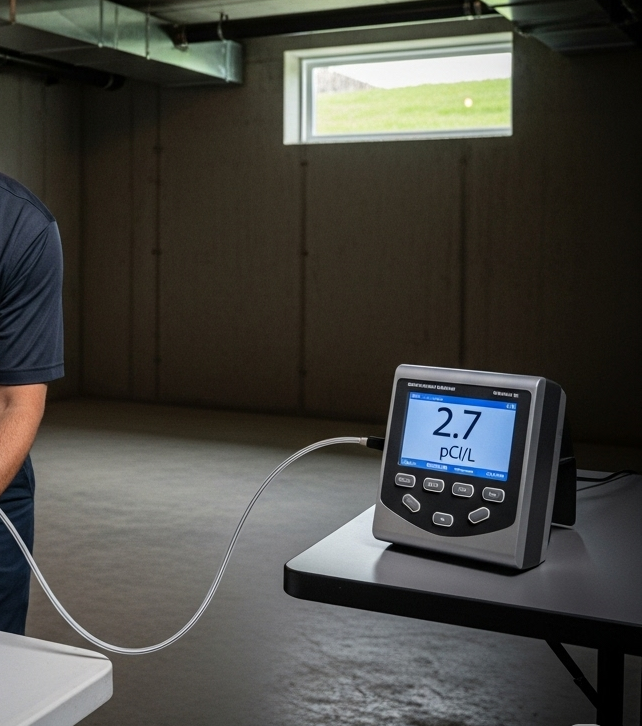
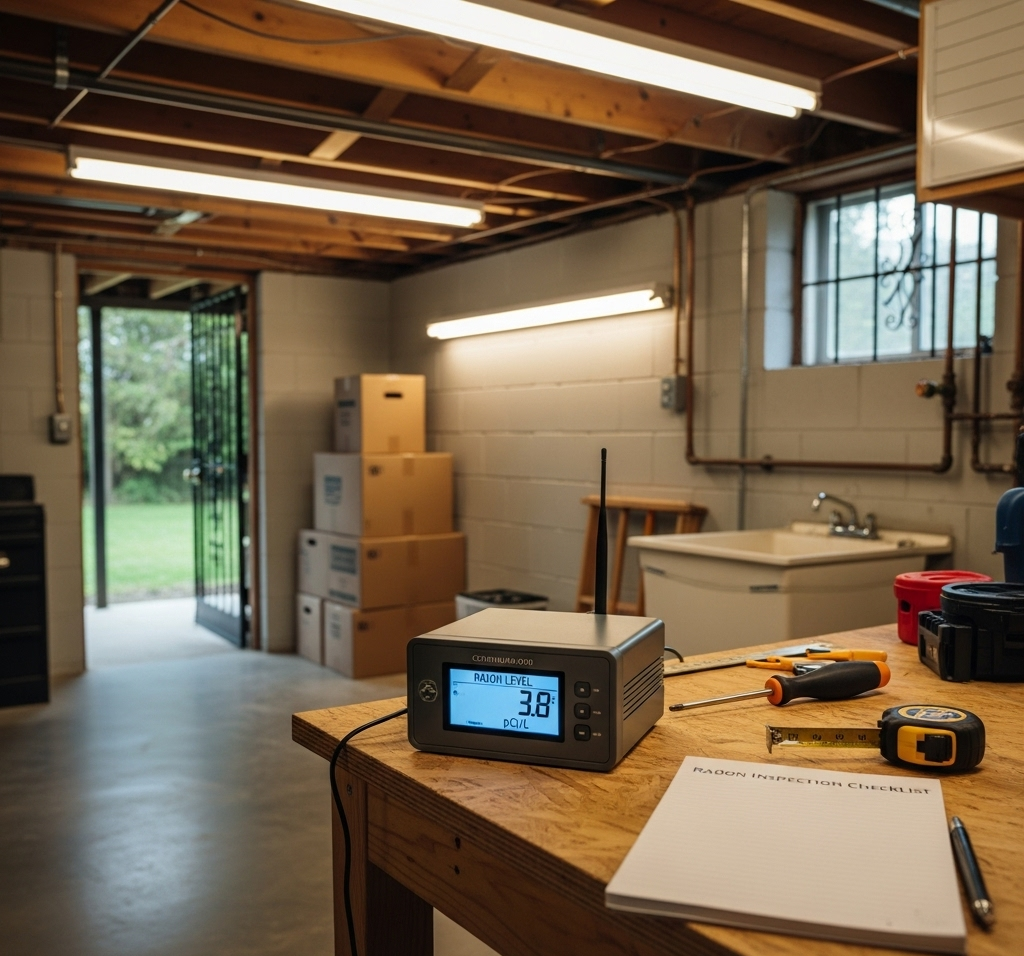
Placement is where a sound measurement starts. Devices go in the lowest livable level of the home, away from drafts, exterior walls, and humid areas, and they are left undisturbed while testing runs. Closed house conditions, meaning windows and exterior doors stay shut apart from normal entry, keep results consistent from one test to the next.
Test type depends on the goal. Short-term tests give a quick snapshot for real estate timelines, long-term tests capture seasonal swings for a better average, and continuous monitors record time-stamped trends. The Minnesota Department of Health recommends continuous radon monitors because they provide more data and may detect tampering.
Results are reported in picocuries per liter. The 4.0 pCi/L action level is the usual trigger for mitigation, and the health department notes that mitigation can be considered even between 2.0 and 3.9. After a system is installed, post-mitigation testing confirms it is reducing levels, and a retest after any major renovation keeps the numbers current.
Why South Saint Paul Residents Trust 1st Defense Radon Testing And Mitigation
Process discipline drives every job. As 1st Defense Radon Testing And Mitigation, we've provided reliable radon testing services in South Saint Paul, MN, by running a meticulous, organized operation where placement, timing, and reporting are documented the same way every time, so results can be compared from one visit to the next.
Owner involvement is part of that. The owner personally handles each installation, arrives when promised, and keeps projects moving on the agreed timeframe, so the person who answers your questions is the person who does the work. Over 10 years of experience supports that hands-on approach and the habit of doing a job right the first time.
Documentation is built for real life. Reports use clear charts, explain test conditions, and recommend next steps, whether that means retesting, continuous monitoring, or mitigation. Real estate professionals, landlords, and families can use those records in disclosures and due diligence, and every report is written so a non-specialist can follow it.
Book Radon Testing Services in South Saint Paul, MN
Curious about the radon level in your basement? We've provided expert radon testing services in South Saint Paul, MN as 1st Defense Radon Testing And Mitigation, and continuous radon monitoring in South Saint Paul, MN is available when you want ongoing visibility rather than a single snapshot of one test period.
Give us a call to schedule a test, or send a message with a few details about the property and any deadlines. We'll recommend the right test type, answer questions about preparation, and explain the report when it is ready, so the next decision is straightforward and you are never left guessing about what a number means.
Landlords and property managers can arrange commercial radon testing in South Saint Paul, MN for multi-unit buildings and shared spaces, and clear mitigation guidance is available whenever the results truly call for it. Reach out when you are ready to get a clear answer about the air in your building today.
happy customers in South Saint Paul, MN
Steve called me and offered to come out and inspect my radon system and fix my problem within a couple hours of calling me. He replaced my defective fan and will be coming back to complete the rest of the issues next week. He was very prompt and knowledgeable.
Did a great job! Fast service, came in under price, would hire again tomorrow.
Very responsive and competitively priced. Did the job quickly and cleaned up afterwards
1st Defense was able to install the radon system the next day. The post installation radon level was down to 0.2. Very satisfied.
This is one of the best companies we’ve ever worked with! Steve is informative and does great work! Radon mitigation system is outstanding and doing exactly what it’s supposed to be doing!
This company provided prompt and gracious service for considerably cheaper than their competitors. I had them replace the exhaust fan in my radon reduction system. I recommend them highly.
Frequently Asked Questions
1. What should I do to prepare a basement for a radon test in South Saint Paul, MN?
Keep windows and exterior doors closed apart from normal entry, avoid running whole house fans, and leave the device where it is placed. We set it in the lowest livable level, and we explain any steps before the test begins.
2. How do I read my radon result in South Saint Paul, MN?
Results are given in pCi/L. The 4.0 level is the action threshold, and the health department suggests considering mitigation between 2.0 and 3.9. Our report explains your reading, the test conditions, and recommended next steps in plain language.
3. Does a sump pit or floor drain affect radon in South Saint Paul, MN?
It can. Open sump pits and drains connect the soil beneath a slab to your basement air, which gives radon a pathway. Sump pit and drain sealing is one of our services and is often paired with testing and mitigation.
4. Can a crawl space be sealed to reduce radon in South Saint Paul, MN?
Sealing and encapsulation can limit the amount of soil gas entering from an exposed crawl space floor and walls. It is one part of a radon strategy, and testing afterward shows whether levels have improved or need further action.
5. What does a continuous radon monitor show that a single test does not in South Saint Paul, MN?
A continuous monitor records time-stamped readings, so you can see patterns, ventilation effects, and unusual spikes instead of one average. It also verifies mitigation performance and can alert you if levels change after the system is running.
6. How does a radon test fit into a home sale in South Saint Paul, MN?
Sellers must disclose test history and reports, so many buyers order a pre purchase radon inspection for independent numbers. Our reports document conditions and results clearly, which helps agents, lenders, and both parties move forward with confidence.
7. Can apartments and commercial buildings in South Saint Paul, MN be tested for radon?
Yes. Commercial and multi-unit programs account for shared ventilation, different foundation types, and occupancy patterns. We design a plan that gathers representative readings across suites and floors and delivers documentation property teams can use.
8. Should I retest after a mitigation system is installed in South Saint Paul, MN?
Yes. Post mitigation testing confirms the system is reducing radon to target levels and gives you a performance baseline. We test after the system is running, document the protocol, and recommend maintenance checks so results stay on track.